
Where Climate Policy Alone Stops Short: What the Implementation Gap Deep Dives Tell Us
By Zheng Cui
India awarded subsidies for 862,000 tonnes a year of green hydrogen capacity. About 8,000 tonnes a year have been commissioned. Indonesia installed village solar in earlier projects and later found systems abandoned, because communities had no access to trained operators or maintenance. South Africa builds about 600,000 vehicles a year. Only about 9% are new energy vehicles, most of them for export, and passenger EVs are projected to be 0.3% of its domestic fleet in 2030.
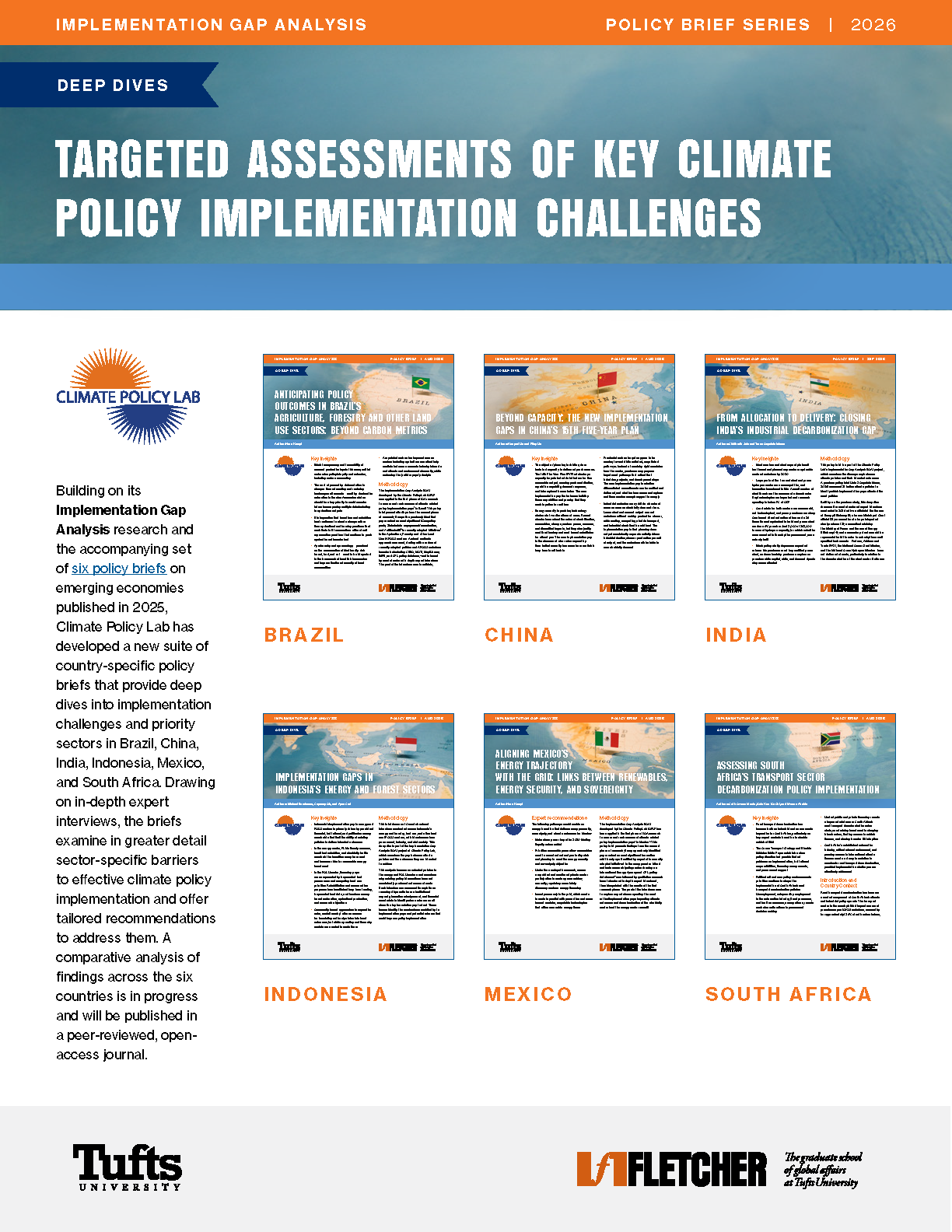
These are the kinds of gaps a new collection of Climate Policy Lab (CPL) briefs sets out to explain. Building on CPL's Implementation Gap Analysis and the six country briefs published in 2025, the deep dives examine one or two priority sectors in Brazil, China, India, Indonesia, Mexico, and South Africa and ask why well-specified policies have not delivered their expected outcomes.
Background: From a ranking of barriers to sector deep dives
An implementation gap is the difference between what an adopted policy is designed to achieve and what it actually delivers. It is distinct from the ambition gap, which asks whether targets are strong enough. A well-designed policy can still underdeliver. The Implementation Gap Analysis (IGA) framework diagnoses why. It sorts the reasons into four clusters: governance and institutional capacity, political economy and interests, financial constraints, and technical and legal constraints. These break down into 17 specific challenges such as competing goals, incentive misalignment, public and private finance, and political will.
In the project's first phase, CPL applied the framework to the climate policy inventories of the six countries, using document review and expert interviews to rank which challenges weighed most heavily in each. The results were published in the first set of six policy briefs. The rankings raised a further question: how do these gaps play out in specific sectors?
The deep dives answer that question. Each takes a priority sector, the instruments governing it, and a new round of expert interviews, and asks why well-specified policies have not produced outcomes at scale: China's power system under the 15th Five-Year Plan, Brazil's agriculture, forestry and other land use (AFOLU), Mexico's electricity grid, Indonesia's energy and forest sectors, South Africa's road transport, and India's iron, steel, and green hydrogen industries.
What's common across the deep dives
The binding constraint is commercial and institutional. Technology is rarely the problem. In India, gas-based direct reduction of iron costs 2.5 times its coal equivalent to build, and green steel carries a 6% premium. Mexico's interviewees saw no constraint in the readiness or cost of solar, wind, and storage. The constraint was stalled investment. Indonesia's respondents said the unresolved issue for village solar was who would own, operate, maintain, and pay for distributed systems over their lifetime. China's brief finds renewable capacity abundant but no evidence yet that storage, demand response, and transmission perform together.
Instruments pay for supply and leave the demand/operating side unbuilt. India has a green steel taxonomy and certification with no purchaser, public or private, required to buy against it. A producer who decarbonizes bears the cost without capturing a return. Its hydrogen incentive rewards allocated capacity rather than commissioned output. South Africa's Electric Vehicles White Paper supports manufacturing and exports but gives little direction on domestic adoption. Indonesia's 100 GW village solar program has a capacity target but not yet an operating model, and only 17 GW has so far entered the national supply plan. Brazil's brief argues that incentives for conservation-minded farming must be consistent across political cycles and large enough to outcompete revenues from cattle and from the illicit economy.
Security, sovereignty, and jobs are legitimate goals, but without guardrails they protect incumbents. China's energy plan treats secure supply as a precondition for the transition. The same logic that funds electrification, renewables, storage, and nuclear power also retain coal backup and coal-to-liquids and coal-to-gas capacity. The gap is the absence of rules separating time-limited insurance from long-term lock-in. Mexico's sovereignty reforms guarantee the state utility CFE at least 54% of electricity supply and give PEMEX preferential rights across the hydrocarbon chain. In Indonesia, PLN plans to keep building coal plants through 2035, which rules out the carbon-credit methodologies that could finance early retirement. In South Africa, an unemployment rate of 32.7%, jobs in the existing auto industry, and fuel-tax revenue make policymakers cautious. Brazil’s second-largest emitting sector, agriculture, has been exempted from the new regulated carbon market.
What stands out country by country
Brazil’s asset already exists, and the job is not to lose it. Avoiding illegal deforestation costs minus 20 to plus 5 dollars per tonne of CO2 equivalent, against 80 to 140 for energy and industry, and preventing loss is cheaper than restoring afterward. Yet states were slow to legislate the Forest Code and land titling because no timelines required them to act. Brazil needs conservation written into agricultural policy itself, incentives that outcompete cattle and the illicit economy, and a measure of success that goes beyond carbon to water, food, and livelihood security.
China has already made the shift the other deep dives call for. Its 15th Five-Year Plan adds indicators for firm renewable output, evening-peak share, and demand response alongside capacity targets. Provincial targets are moving toward negotiated, differentiated pathways that will need verification and support for less-resourced regions. And industrial emissions may fall because steel and cement output is falling with the property sector, which planning could mistake for decarbonization. China needs published performance data and reporting that separates structural decline from cleaner production.
India's industry is two industries. Of roughly 1,200 iron and steel entities, the top 30 to 40 have the capital, technology access, and skills to decarbonize and are already doing so. The rest run older technology with no monitoring, reporting, or verification, cannot compute the embedded emissions the EU's border adjustment will demand, and are invisible to any instrument that depends on measurement. Both tiers import their technology, and research spending sits below 1% of GDP. India needs instruments differentiated by firm size, and an enforced procurement mandate so that decarbonizing has a buyer.
Indonesia's finances constrain what it can plan. PLN's fiscal pressures, fossil-fuel subsidies, and administered tariffs make early coal retirement financially unattractive, weaken the case for replacing coal even as solar costs fall, and raise the risk on every renewable project tied to the utility. In the forest sector, financial, institutional, and political economy constraints interlock. Rehabilitation funding covers three of ten years, and no institution arbitrates competing land claims. Indonesia needs finance and institutions built to last the life of the asset.
Mexico has the resources and the technology but lacks investment. A low-investment path of $20 to $35 billion buys maintenance and blackouts. A high-investment path of $130 to $210 billion, with transmission leading generation, would add 200 to 300 TWh a year of renewable electricity to a system that now generates 350 to 370 TWh, three-quarters of it from non-renewable sources. Reforms that favor CFE, dissolve the regulator, and leave the 2030 clean-energy target non-binding push toward the low path. Mexico needs a binding target, renewables first in dispatch, regulated private participation, and grid investment that leads generation.
South Africa has strong reasons to act and stronger reasons to wait. Nearly half the vehicles it builds go to markets moving away from combustion engines, but unemployment, jobs in the existing auto industry, and fuel-tax revenue make policymakers cautious. Its strategies set direction without assigning responsibilities, financing, or timelines, and limited public and private finance slows charging infrastructure and vehicle purchase alike. South Africa needs an implementation roadmap, and policy that links domestic EV adoption to the manufacturing it already supports.
What the results suggest
First, the deep dives argue for changing how ambition is measured. Most targets in the study are stated in outputs: gigawatts, tonnes of capacity, hectares, a clean-energy share. Raising those numbers is unlikely to narrow the implementation gap, because the barriers that stopped the outcome at the current target will stop it at a higher one. Ambition stated in outcomes creates a different kind of obligation, one that a buyer, an operator, or a grid must eventually meet.
Second, barriers interlock rather than act alone, and gaps will continue to develop and change with implementation. Indonesia's financing is harder to mobilize because operating responsibilities are unclear, and its reforms are harder to pass because fossil incentives make them politically costly. The China's first-phase ranking pointed at capacity as the key gap, with now newly discovered gaps in coordination, verification, and accounting. A diagnosis has a shelf life, and the framework should be reapplied as instruments change.
The full set of briefs is available here.