
What’s Holding Back Türkiye’s Climate and Energy Transition?
Türkiye has made major climate commitments in recent years. The country has pledged to achieve net-zero emissions by 2053 and has positioned renewable energy and energy efficiency more prominently within national planning. On paper, these commitments signal an intention to align with the global transition toward low-carbon development.
But ambition alone is not enough.
Our new policy brief, Unlocking Türkiye’s Climate Policy Tools: From Carbon Lock-in to Policy Gaps, argues that Türkiye’s current policy mix is not yet capable of delivering the scale of transformation required for long-term decarbonization. While Türkiye’s climate targets continue to evolve, many of the policy instruments needed to support deep decarbonization remain either underdeveloped or missing altogether.
This research, a collaborative effort between Climate Policy Lab and Istanbul Policy Center at Sabancı University, reveals that Türkiye’s climate policy framework remains heavily reliant on regulatory instruments, with limited use of the market-based, fiscal, and innovation-driven policy tools that would be needed to drive implementation. Approximately 70% of the policies analyzed are prescriptive measures such as standards, directives, and mandates. While these have helped establish a foundation for climate action, regulation alone is not sufficient to deliver the scale, speed, and investment required for a competitive low-carbon economy.
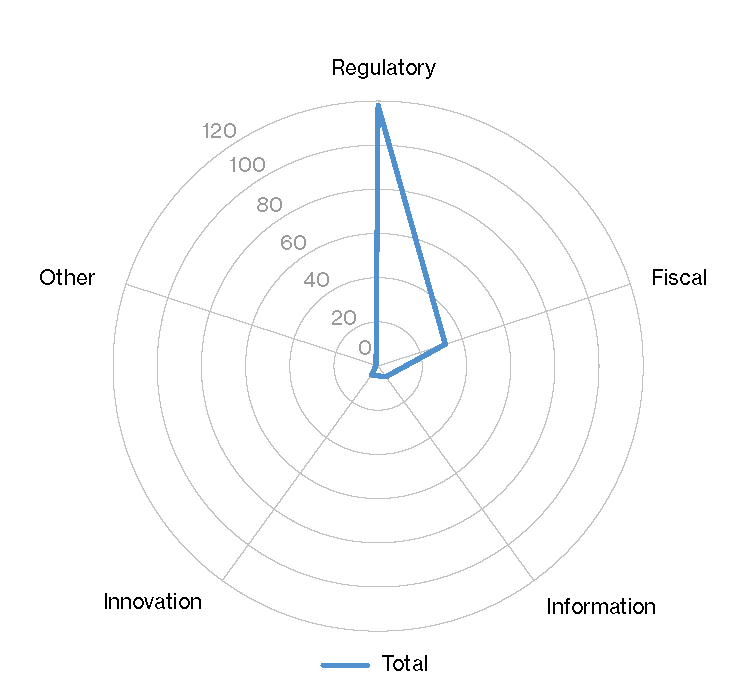
Distribution of Policy Instruments Across Türkiye’s Active Climate Policies
Türkiye’s climate policy efforts are concentrated in the power and energy sectors. Beyond the power sector, there are substantial policy gaps across transport, buildings, industry, agriculture, and forestry. While policies are in place across these sectors, many lack measurable targets, diversified policy instruments, and clear implementation pathways. For example, policies in the building and industrial sectors often reference energy efficiency improvements without specifying retrofit rates or annual energy-saving targets.
A recurring theme throughout the policy brief is the persistence of “carbon lock-in.” Türkiye’s economic development model has historically prioritized fossil fuel-based energy security, construction, and extractive industries. These dynamics reinforce high-carbon infrastructure and institutional path dependencies. Continued support for fossil fuel infrastructure, combined with the absence of a clear coal phase-out pathway, further entrenches this trajectory.
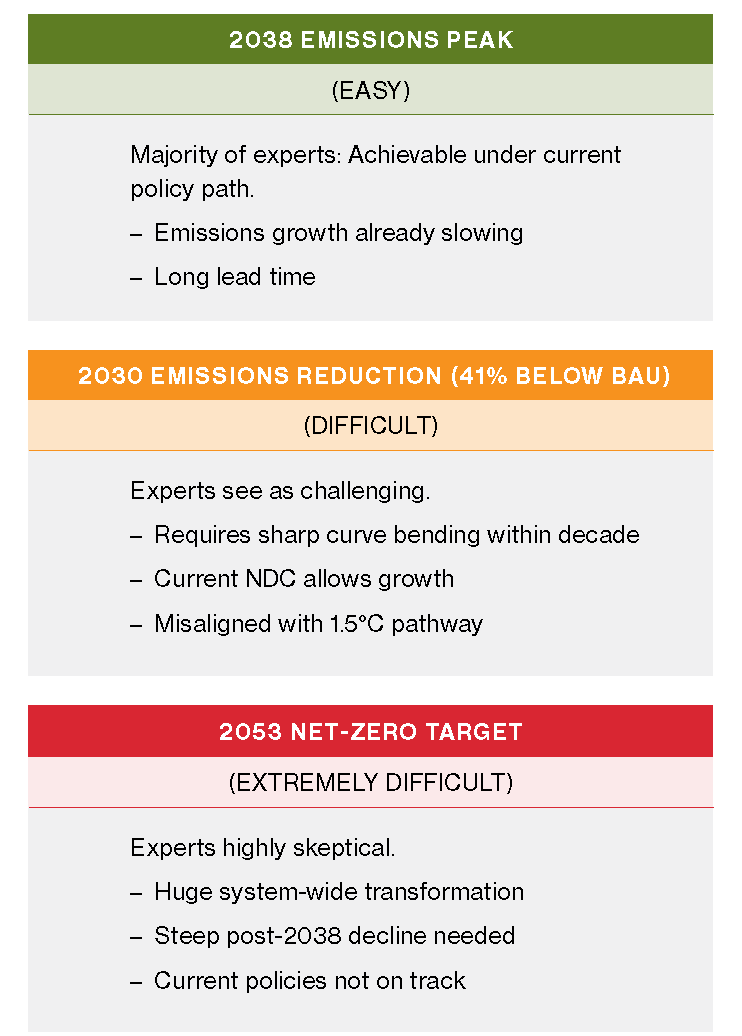
Türkiye’s Climate Target Feasibility Gap (Expert Assessment)
The expert survey results reinforce these concerns. Most experts viewed the country’s 2038 emissions peak target as relatively easy to achieve under current trends. However, far greater skepticism emerged around the country’s other medium- and long-term climate goals. The majority of experts considered the country’s 2030 emissions reduction target of 41% difficult to achieve, while the 2053 net-zero target was viewed as extremely difficult under existing policy conditions.
Experts did see potential for near-term peaking in a number of existing climate policies, including concessional green finance for industry, renewable energy feed-in tariffs (FiTs), streamlined rooftop solar permitting, energy efficiency regulations, and vehicle taxation reforms. However, the experts highlighted major implementation challenges around the voluntary carbon offset market program, electricity grid fee discounts for renewables, transport and forestry regulations, waste management initiatives, and broader institutional coordination.
Taken together, these insights suggest that Türkiye’s decarbonization pathway will require a more balanced and coordinated policy mix that goes beyond regulations to include market-based incentives, innovation support, public engagement, and stronger institutional alignment. Experts also point to the need for a phased introduction of an emissions trading system, expanded support for innovation in storage and grid modernization, stronger climate governance, and more inclusive climate finance that supports SMEs, vulnerable communities, and coal-dependent regions.
These lessons, grounded in our comprehensive policy inventory and expert survey, are elaborated further in the full policy brief, which presents detailed analytical findings and actionable recommendations. With Türkiye set to host COP31, there is a clear opportunity to move decisively on these recommendations, demonstrating credible leadership and strengthening confidence in its climate transition pathway.