
What Drives the Green Steel Transition? Lessons from Germany and South Korea
By Soyoung Oh
Steel is part of our everyday life in ways we don’t even realize. It forms the backbone of buildings, bridges, automobiles, wind turbines, and countless products that underpin economies. Its ubiquity comes at a cost. Steel production accounts for roughly 7–8% of global GHG emissions, making it one of the most important sectors to decarbonize. Unlike electricity, which can be generated by renewable technologies that have become increasingly cost-competitive, producing low-carbon steel remains expensive and technologically challenging.
Similar Ambitions and Technological Capabilities, Differing Progress
Many firms and governments recognize the challenge of decarbonizing steel. Around the world, firms have introduced hydrogen-based direct reduction iron (DRI) and electric arc furnaces, while governments have implemented related subsidies and carbon pricing. But despite similar ambitions, progress has varied.
My recently published paper in Energy Research & Social Science asks a simple question: Why has Germany moved much faster toward green steel than South Korea, even though both are technologically advanced, export-oriented manufacturing economies?
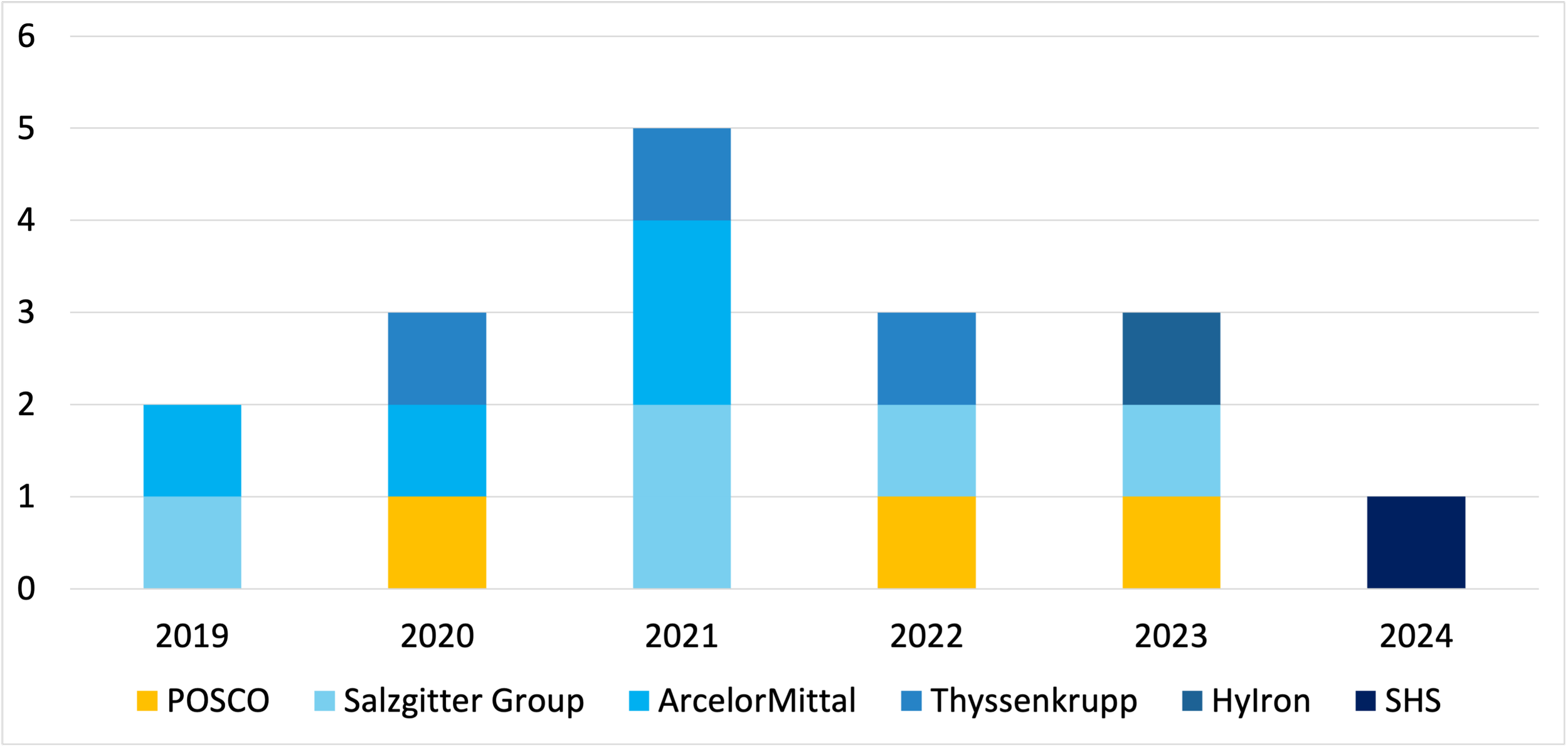
At first glance, the two countries appear similar – both have globally competitive steel companies, sophisticated engineering capabilities, national climate commitments, and public investments in clean technologies. South Korea’s auto exports are hitting a record high, fueled by strong sales of electric and hybrid vehicles. Yet Germany has launched substantially more green steel projects, while South Korea has progressed more slowly.
Figure 1. Number of green steel projects by company and announcement year in Germany (in blue shades) and South Korea (in yellow)
Source: Author, based on the dataset by LeadIT (2025)
Note: Includes demo, pilot, and full-scale projects with a primary commitment to low-carbon production routes (hydrogen(H2)-DRI, EAF, or CCUS), excluding R&D partnerships.
Expert Interviews Reveal Differing Expectations
Conventional explanations often focus on technology or state capacity. But these factors alone cannot explain why countries with comparable capabilities pursue different pathways.
Drawing on 33 expert interviews with policymakers, industry representatives, researchers, and civil society organizations in Germany and South Korea, together with policy documents and company reports, I found that the key difference lies elsewhere: credible expectations about future markets.
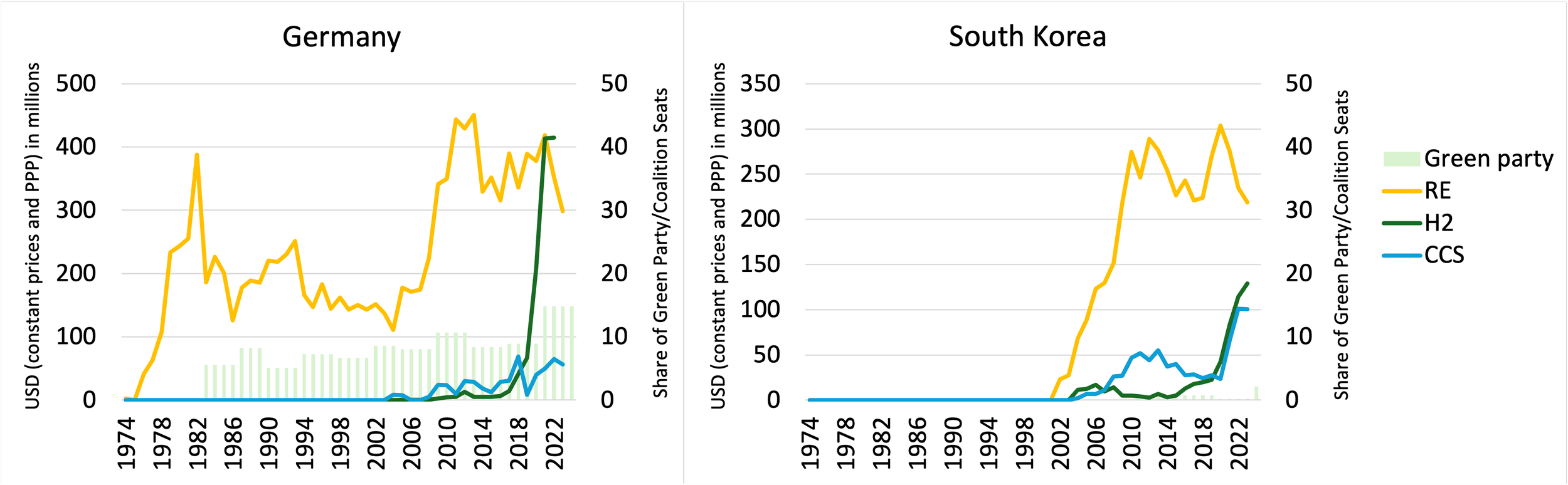
Green steel produced via a hydrogen-based process is significantly more expensive than conventional steel produced in a blast furnace. Companies will invest in new production technologies only if they believe customers will eventually pay for cleaner products. Germany increasingly provides that confidence.
Figure 2. Share of seats of Green Party/Coalition and Public RD&D investments on Renewable Energy, Hydrogen, and CCS between 1974 and 2024 in Germany (L) and South Korea (R)
Source: Author, based on Comparative Political Dataset (updated in November 2024), (Armingeon et al., 2024), and IEA’s RD&D Dataset (IEA, 2025)
The European Union has gradually ratcheted up the stringency of carbon pricing through reforms to the EU Emissions Trading System (EU ETS) and the introduction of the Carbon Border Adjustment Mechanism (CBAM), while providing generous national and subnational public subsidies. Together, these policies do more than increase the carbon price. They signal that low-carbon steel will become economically viable in the future. Companies that once opposed stronger climate policy now negotiate how to implement the transition rather than whether it should occur at all. A broad pro-climate coalition that includes government, industry, labor unions, and civil society has created a reinforcing loop that bolsters the credibility of future green steel demand, accelerating the green steel transition.
South Korea presents a different picture. The country has invested in research, development, and demonstration (RD&D) for green steel, but many of its steel exports go to markets that have not yet created strong demand for low-carbon steel.
Without clear market incentives, firms continue to view higher carbon prices primarily as a competitiveness risk. Consequently, the Korean government has focused more on reducing technological risk than creating demand for green products. Subsidies alone help firms develop technologies, but they do not guarantee that customers in Japan, India, Mexico, China, and the United States will buy low-carbon steel once it is produced.
No One-Size-Fits-All Strategy for Industrial Decarbonization
We can extend these lessons well beyond Germany and South Korea.
Many emerging economies are hoping to decarbonize heavy industries while maintaining export competitiveness. My findings suggest that governments cannot simply copy another country’s subsidies or carbon prices without factoring in the political economy context. Countries whose exports depend on markets without strong climate demand may face structural challenges that slow industrial decarbonization. This shifts the conversation to how governments can create credible markets through expanding public procurement policies or by helping find a niche market willing to pay a premium.
Ultimately, industrial decarbonization is not only about investing in more technologies. It is about reducing uncertainty. Firms invest when they believe future markets will reward cleaner production. Building those expectations may be one of the most critical and often overlooked tasks for governments seeking to accelerate the transition to net zero.
As countries increasingly pursue green industrial policies, understanding how to combine carrots and sticks to shape market formation will become essential not only for steel but also for other hard-to-abate sectors.
Read the full paper here.