
Bethany Tietjen: Rethinking Resilience
By Pamela Lava Moreno
Communications Research Assistant, Center for International Environment and Resource Policy (CIERP) and Climate Policy Lab (CPL) | The Fletcher School of Law and Diplomacy, Tufts University
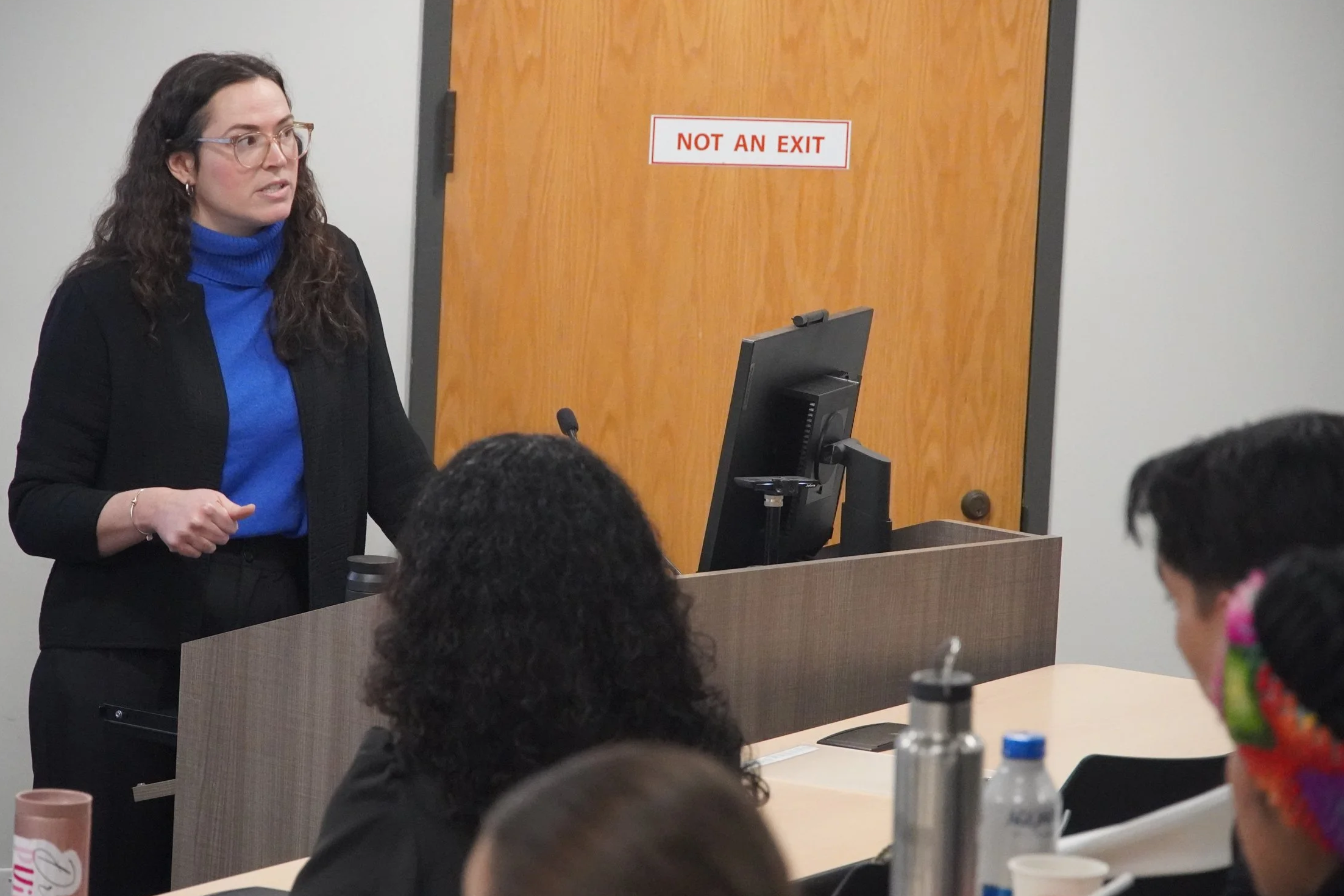
To understand why major disasters, occur, you must first understand: Who is the affected community? Where do they live? How is their society gendered? What tools do they have in place to prevent major disasters? And what sectors does the governing body prioritize? Only by understanding these questions can effective climate adaptation plans begin.
Bethany Tietjen, a Postdoctoral Researcher at the Climate Policy Lab, explores many of these questions through her research on climate disaster preparedness and adaptation. Her work examines how communities prepare for and respond to climate-related disasters, and how policy and governance can better account for the different ways people experience climate risk. Her research doesn’t just focus on how communities can become more resilient, but also who gets to decide what resilience should look like.
Bethany’s experiences across regions and cultures have helped shape her academic interest. Before coming to The Fletcher School, she lived and worked in Southeast Asia, including Thailand and Vietnam, where she developed a deep appreciation for how local context influences the ways communities respond to environmental challenges. She also lived in Guatemala, where witnessing the effects of drought and crop losses on farmers deepened her interest in climate adaptation.
A common theme in Bethany’s research is that adaptation is not a one-size-fits-all solution. She emphasizes that “it’s really important to give communities a lot of sovereignty in their choices of what they can do.” For Bethany, effective climate policy requires more than identifying a technical solution. It requires an understanding of what an affected community needs, what resources are available, and what solutions the community itself considers feasible and appropriate. Climate adaptation doesn’t happen in isolation. Communities and governing bodies must also focus on food security, health care, education, infrastructure, and economic stability. These priorities may make climate adaptation a secondary concern. It’s important to recognize that a community’s ability to withstand a major disaster is not only shaped by the climate itself, but by the social and political conditions that exist long before it occurs.
This perspective shapes the way Bethany thinks about the term: natural disaster. Through a research project with Dr. Erin Coughlan de Perez at the Friedman School, Bethany worked with an interdisciplinary team of researchers partnered with the American Red Cross to better understand gaps in disaster preparedness and response. The experience introduced her to research examining how disasters are socially constructed and challenged the idea that the consequences of a disaster are simply the result of a natural hazard. For example, a hurricane is considered a natural hazard, but the extent of the damage it causes depends on other factors that have nothing to do with the storm. Infrastructure, preparedness, access to resources, governance, and social conditions can all shape who is the most vulnerable and how quickly communities recover. This type of thinking shifts the attention to the conditions that exist before a disaster occurs and the policies that can help communities prepare before the storm hits.
“Climate impacts are gendered because society is gendered.” Bethany went into detail about how people experience climate risks differently because societies assign different roles, responsibilities, resources, and opportunities to different groups of people. In 1991, a major Bangladesh cyclone caused a disproportionate share of deaths among women and young children. This disparity came from social expectations that restricted women to caretaking roles at home. When a crisis hits, this expectation of remaining at home, paired with a lack of swimming ability or knowledge of local evacuation strategies, can significantly increase their vulnerability. Understanding these social dynamics is therefore essential to preparing communities before a disaster occurs. This perspective is part of what led Bethany to bring climate policy and gender and intersectional analysis together in her own academic work, which is why she continuously questions what societies consider normal and examines how seemingly ordinary structures can be deeply shaped by inequality and power.
Advice and Next Steps:
Her interdisciplinary approach has continued to develop at Fletcher and through her work at the Climate Policy Lab. She describes the Fletcher community as a unique multicultural environment that has allowed her to think about her research questions as part of larger global challenges. Looking ahead, Bethany is particularly interested in the role of hazard insurance in helping communities recover from disasters. Insurance is an important tool to help people rebuild, but she plans to look into how insurance programs can be designed to strengthen resilience and avoid maladaptation.
For students interested in climate policy, gender and intersectional analysis and/or environmental research, Bethany’s advice is to pursue what excites you. Start with the problems that make you curious, recognize that there are many different perspectives on how an issue can be addressed, and allow your questions to evolve. For Bethany, following that curiosity has meant crossing disciplines, cultures, and regions to better understand not only how communities experience climate risk, but how they can shape their own paths toward resilience.